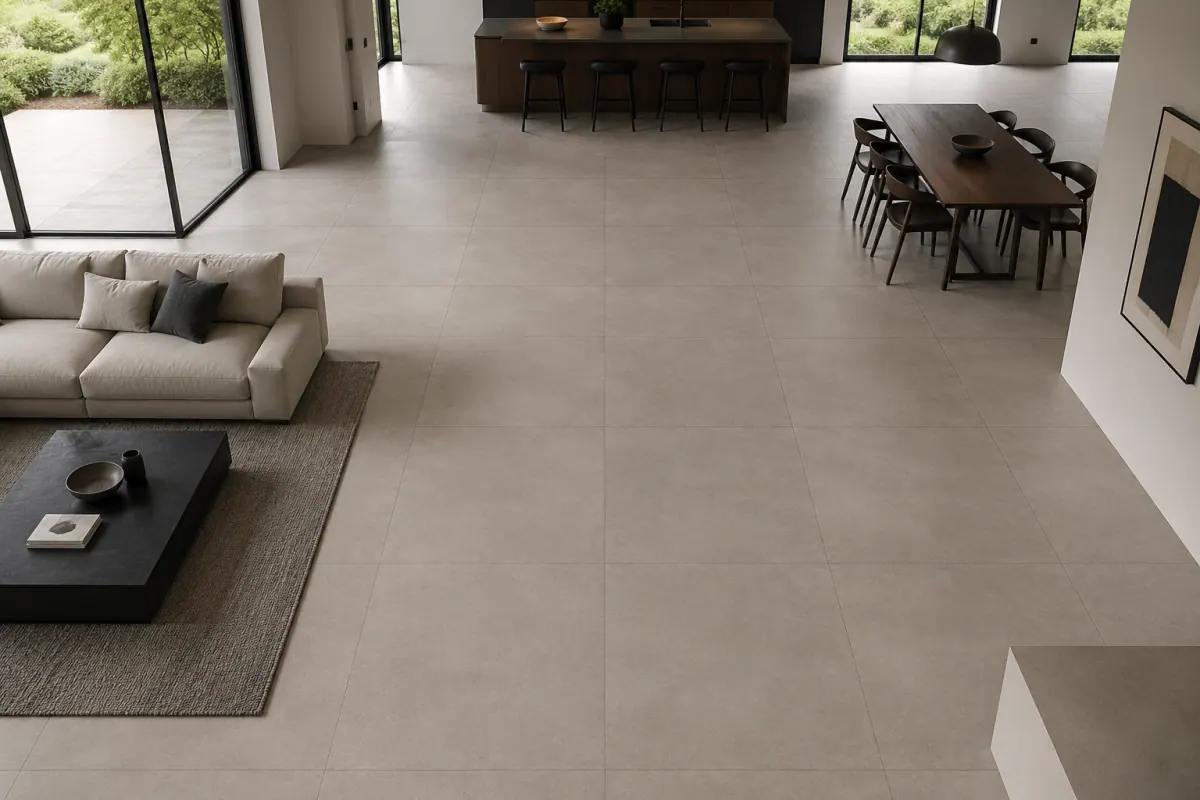
A modern home does not automatically call for the largest tile or the coolest grey. The right floor tile brings calm, suits the light and stays practical in daily use. This guide walks through the choices that matter in six steps, with guideline values you can check against your plan straight away.
Step 1: start with use and space, not with colour
How a room is used matters more than its colour. An open-plan living space with a kitchen sees chairs, crumbs, grease and wet feet every day. An entrance hall gets sand and grit under shoes, and that is abrasive. A bathroom needs grip on a wet floor.
Ceramic floor tiles suit all of those situations because they are hard, colourfast, watertight and acid-resistant. For glazed tiles, the PEI class indicates how wear-resistant the glaze is: for residential floors PEI 4 is the safe choice, PEI 3 is sufficient for bedrooms and walls. Through-body porcelain has no glaze layer and therefore no PEI class: the colour runs through the whole tile, so a scratch or chip is barely noticeable.
Is underfloor heating planned? Then the thermal resistance of the finish counts too. Ceramic scores very well there. Read more in Ceramic tiles and underfloor heating.
Step 2: choose the look: concrete-look, stone-look or marble-look
Modern is not a fixed style, but in practice you end up with three families:
- Concrete-look: even, calm, architectural. Works in a restrained interior and combines with wood and black steel. Series such as Siena, Cortona and Lusano. Also read Concrete-look tiles for a clean interior.
- Stone-look: the soft pattern of limestone or travertine, warmer than concrete without becoming busy. Series such as Limestone, Pietra, Tavira and Essence.
- Marble-look: veins and contrast, from subtle to pronounced. Strong on a wall or in a hall; on a large floor only in a calm variant. Read Marble-look tiles: benefits and what to check.
Rule of thumb: in continuous zones, stick to one main tile and at most one accent material. Every extra change of material makes a modern space more restless.
Step 3: format and laying pattern
The format determines the number of grout lines and therefore how calm the floor looks.
- 60x60 cm: the workhorse. The logical choice in rooms under 15 to 20 m², in halls, bathrooms and wherever there are many doors or recesses. Least cutting waste.
- 80x80, 90x90 and 100x100 cm: square large format for open-plan living spaces from 25 to 30 m² upwards. Fewer joints, more uninterrupted surface.
- 60x120 cm: rectangular large format. On the floor in a straight bond or with an offset of at most one third, never a 50% offset (brick bond). Also ideal as a wall tile from the same series.
Allow 10% cutting waste for a straight laying pattern and 15% for a diagonal layout or many interruptions. The tile calculator works that out per format for you. Large formats need a flat substrate and precise installation: read Large tiles: benefits, drawbacks and installation.
Step 4: finish, grip and grout joint
- Matt is the standard for a modern residential floor: calm, forgiving of scratches and stains. Many matt series achieve slip resistance class R10, which is more than sufficient for a living space or kitchen.
- Polished (poli) reflects light and gives a luxurious effect, but is more slippery (R9) and shows scratches and dull patches sooner. Better for walls and dry zones than for a floor with children, pets and sand.
- Joint width: rectified tiles (straight-cut edges) can be laid with a 2 to 3 mm grout joint. Non-rectified tiles need 3 to 5 mm.
- Grout colour: choose the tone of the tile or one shade darker. A lighter grout pulls the grid forward and discolours sooner.
Step 5: technical checks before you order
- Material: glazed ceramic, porcelain or through-body porcelain. Indoors all three are suitable. Porcelain has a water absorption below 0.5% and is therefore also frost-resistant: necessary if the same tile continues outdoors.
- Thickness: indoors 8 to 11 mm, depending on series and format. Outdoors 20 mm.
- Substrate: flat, dry and load-bearing. With large formats a tile levelling system is not a luxury but standard.
- Underfloor heating: flexible adhesive (class C2 S1) and a completed heat-up protocol for the screed.
- Shade and calibre: order all tiles for one project at once, so they come from the same production batch. Every box carries a shade and calibre code; these must match. Keep one extra box aside for later repairs.
Step 6: budget per square metre, not just the tile price
Our product pages show the price per m² excl. VAT, next to the manufacturer's recommended price. How that pricing model works is explained on Pricing and manufacturer model. On top of that, allow for:
- cutting waste (10 to 15%),
- adhesive, grout and possibly levelling clips,
- transport and pallets, depending on volume and site access,
- installation. Il Mondo Tiles does not carry out installation itself, but recommends independent installers on request.
Are you a tiler or contractor? See the conditions on For professionals.
Conclusion
A modern floor succeeds on proportion and calm, not on trend. Start from use, choose one look and one main format, check finish and technical details, and look at the full budget. Then come to the showroom in Merelbeke with your plan, dimensions and photos: there you compare formats and shades in real light and we confirm series, quantity and delivery.
Continue your research
FAQ
Frequently asked questions
Which format works best in a modern living space?
In an open space from 25 to 30 m² upwards, 90x90 or 60x120 gives the calmest result. In compact rooms or with many doors and recesses, 60x60 remains more logical: less cutting and fewer narrow offcuts.
Should I choose a matt or a polished floor tile?
For a residential floor, matt, preferably with slip resistance class R10. Polished reflects beautifully but is more slippery and shows scratches sooner. Use poli on walls or in a hall without sand and water instead.
Ceramic, porcelain or through-body porcelain: which do I choose?
Indoors all three are suitable. Choose through-body porcelain for intensive or commercial use, because a chip does not show. Choose porcelain (water absorption below 0.5%) if the tile also continues outdoors.
How much extra should I order?
10% for a straight laying pattern, 15% for a diagonal layout or many interruptions, plus one spare box from the same batch for later. The tile calculator works this out per format.
Are ceramic floor tiles suitable for underfloor heating?
Yes. Ceramic has a very low thermal resistance and is dimensionally stable under temperature changes. Use flexible adhesive and let the screed dry and go through its heat-up cycle first. Read the article on underfloor heating for the details.
Il Mondo Tiles
Compare tiles in the showroom
Bring measurements or photos. We help you compare sizes, finishes and pricing for your project.