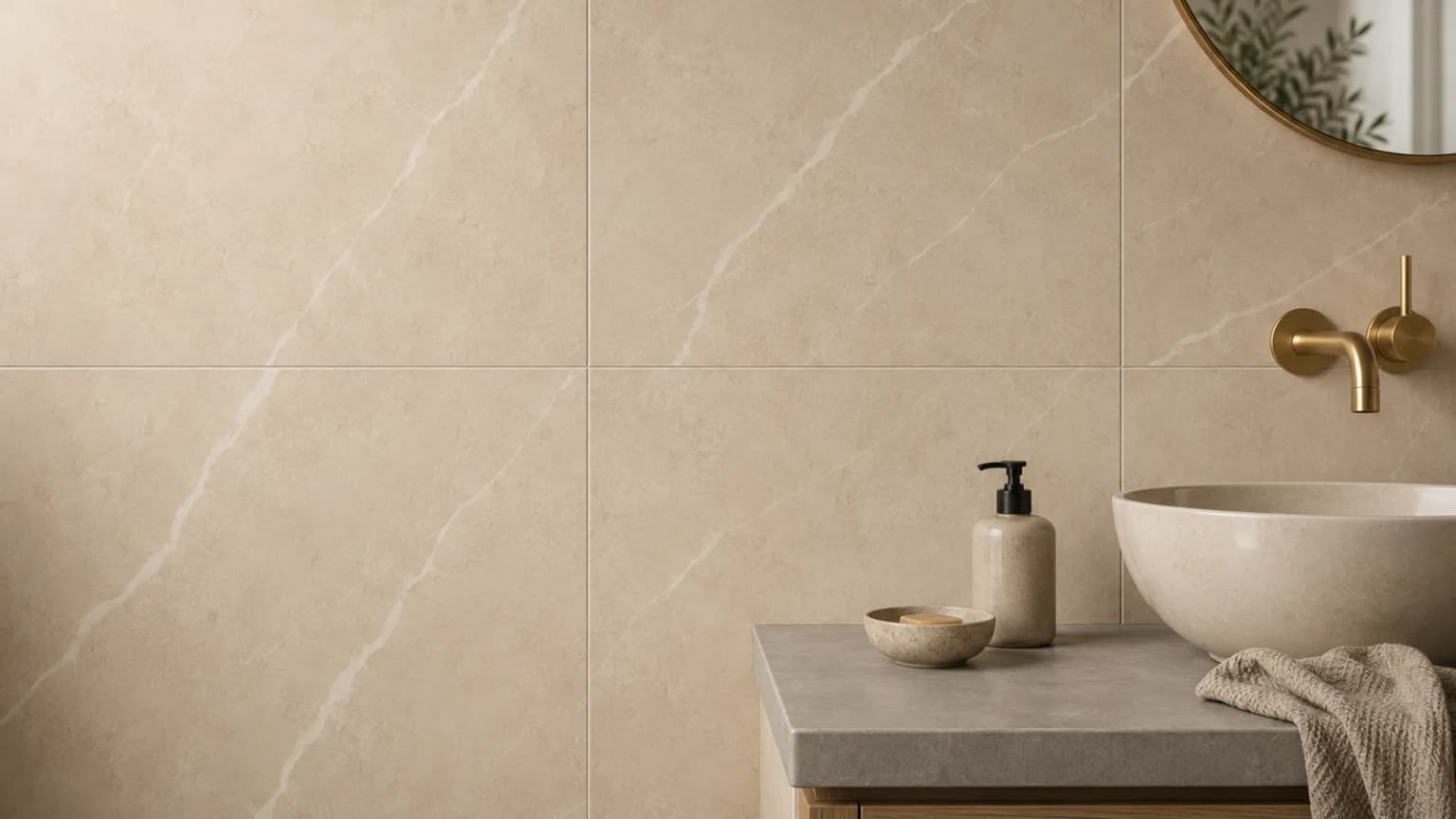
Marble-look remains popular because it comes close to the appearance of natural stone without the upkeep of porous marble. Not every marble-look is a good choice, though: the difference between elegant and too busy lies in the pattern, finish, format and application. Below you will find what to check, with examples from our range.
Why ceramic marble-look rather than real marble
Real marble is limestone: porous, soft and sensitive to acids. Lemon, vinegar, wine or an acidic cleaner etch dull marks into the surface. It has to be sealed, it scratches, and at 20 mm thick it weighs twice as much per m² as a ceramic tile.
Ceramic marble-look is a print on porcelain. Water absorption is below 0.5%, the surface is acid- and stain-resistant, colourfast and needs no sealing. A 60x120 cm format in 9 to 10 mm thickness is lighter and flatter than the same slab in natural stone, and the price per m² is considerably lower.
To be fair: a print repeats. A manufacturer prints a limited number of faces (unique print designs). The more faces, the more natural the overall result. Ask about it when comparing.
Vein pattern, variation and repetition
Not every marble-look has the same intensity:
- Calm: a fine grey vein on a white or beige base. Works on large floors and in small bathrooms. For example Statuario Latte or Ural Pearl.
- Expressive: gold or dark veins with contrast, such as Norda Gold Poli, Aurelia Gold Poli or Vesuvio Dark Grey Poli. Strong on a wall, in a hall or around a washbasin; on a large floor it quickly becomes dominant.
Practical rules to avoid repetition: mix tiles from several boxes, dry-lay 2 to 3 m² before you start bonding, keep the vein direction consistent and check how the veins meet at corners and recesses. With 60x120 on a wall you can place two tiles mirrored (bookmatched) for a symmetrical effect. See the full range at Marble-look tiles.
Polished, matt or structured (carving) finish: choose by use
- Polished (poli): mirror-like, maximum luxury effect, but slippery (R9) and more prone to visible scratches and dull patches. Polishing sometimes opens micropores in the surface; ask whether the series has been factory-treated against staining. Ideal for walls, bathroom walls, a hall or a living space without wet zones.
- Matt: calmer, more forgiving in maintenance, often R10. The logical choice for a floor in a living space or kitchen.
- Structured (carving) finish: a light relief that follows the veins. Light plays across the surface and dirt is less noticeable. See Statuario Latte and the Ural series.
Where marble-look works: bathroom, living space, wall
- Bathroom: polished 60x120 on the wall and matt on the floor from the same series is a classic combination. For the shower floor, choose a smaller format or a mosaic variant with a fall towards the drain and preferably slip resistance class R11. See the bathroom tiles.
- Living space: matt 60x120 or 90x90 in a calm variant. Combine with a calm wall and furniture without additional pattern.
- Wall and accent: kitchen splashback, TV wall, entrance hall, washbasin area. This is where the expressive variant belongs.
Not everything has to be marble-look. A calm concrete-look or stone-look floor next to a marble-look wall gives the pattern room to breathe.
Format, grout colour and layout plan
Large formats (60x120) give fewer joints and let the pattern run on. Lay them in a straight bond or with an offset of at most one third, never a 50% offset (brick bond). Rectified tiles are laid with a 2 mm joint (minimum) or 3 mm for a little more tolerance.
Grout colour: choose the base tone of the tile. With white marble-look that is light grey or off-white rather than pure white, which discolours quickly. A dark contrasting grout makes the grid visible and breaks the marble effect. For skirting, cut strips from the same tile. Large format on a wall or floor needs a flat substrate and a tile levelling system to avoid height differences.
When marble-look is not the best choice
- In an interior that already has a lot of pattern, contrast or texture.
- In small rooms with a lot of cutting: veins that are cut off everywhere look messy.
- Polished on a floor with sand, pets or wet feet: slippery and scratch-prone.
- Outdoors: polished tiles are too slippery there; choose a matt porcelain variant with R11 instead.
An alternative with the same calm: stone-look such as Limestone, Essence or Pietra.
Conclusion
A good marble-look is a balance between pattern, finish, format and application. Calm on the floor, expressive on the wall, polished where it stays dry, matt where you walk. In the showroom in Merelbeke, compare several tiles from the same series side by side, in real light, and look at the veins over a larger area than a single tile.
Continue your research
FAQ
Frequently asked questions
Are marble-look tiles suitable for the bathroom?
Yes. Polished works on the wall; on the floor choose matt with slip resistance class R10 or higher. For the shower floor, a smaller format or mosaic with R11 and a fall towards the drain.
Are marble-look tiles easier to maintain than real marble?
Yes. Ceramic marble-look is not porous, is acid-resistant and does not need sealing. Clean polished tiles with a pH-neutral product and without abrasives.
Should I choose large marble-look tiles?
60x120 is the standard format for marble-look: fewer joints and a continuous pattern. That requires a flat substrate, double application of adhesive and a tile levelling system.
How do I avoid visible repetition of the pattern?
Choose a series with many different faces, mix from several boxes and dry-lay a few m² before you start. Keep the vein direction consistent.
Can you also provide an installer?
Il Mondo Tiles does not carry out installation itself. On request we recommend independent installers or contractors.
Il Mondo Tiles
Compare tiles in the showroom
Bring measurements or photos. We help you compare sizes, finishes and pricing for your project.