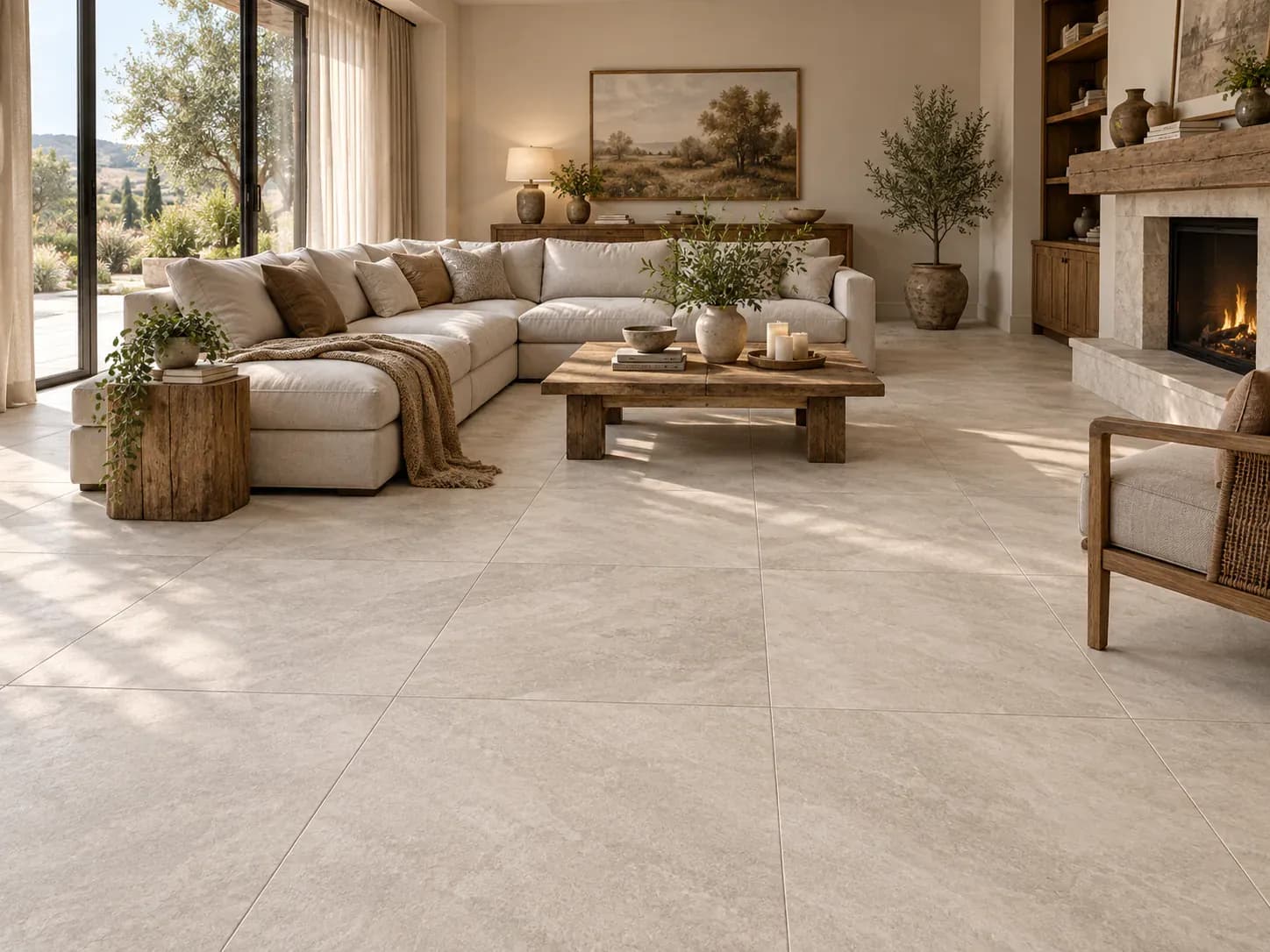
Ceramic and underfloor heating are the standard combination in most new builds and renovations, and rightly so. Problems rarely come from the tile itself, but from a damp screed, a rigid adhesive or missing movement joints. This article sets out the figures and the order of work.
Why ceramic performs well on underfloor heating
Underfloor heating works best with a finish that passes heat on quickly. Ceramic has a thermal conductivity of roughly 1.0 to 1.3 W/mK; parquet and laminate sit around 0.15 to 0.2 W/mK. A 10 mm tile has a thermal resistance of roughly 0.01 m²K/W. Underfloor heating manufacturers set a maximum of around 0.15 m²K/W for the complete floor finish; ceramic uses hardly any of that.
The result: the water flow temperature can be lower, the floor responds faster and a heat pump runs more efficiently. Ceramic is also insensitive to moisture, barely expands when heated and does not deform. Floor cooling in summer (passive cooling via the heat pump) is no problem with ceramic either, whereas wood is sensitive to it.
First a dry screed, then heat up, then tile
Most problems with tiles on underfloor heating arise before the first tile is laid:
- Drying time: a cement-based screed needs at least 28 days. Rule of thumb: 1 week per cm up to 4 cm, then 2 weeks per additional cm. An anhydrite screed (calcium sulphate) dries more slowly, has to be sanded and primed and requires a lower residual moisture content. Residual moisture is measured with a CM (carbide method) test; with underfloor heating the limit is around 2% for cement screed and 0.5% for anhydrite (follow the screed manufacturer's value).
- Heat-up protocol: before tiling, heat the screed up fully once and let it cool down again. Common practice is to start at a flow temperature of around 25 °C, add 5 °C per day up to the maximum design temperature, hold that for several days and then step down gradually. That way shrinkage and residual moisture come out before the tiles are laid, not after.
- During tiling: heating off or at low temperature (floor below 18 to 20 °C). Restarting only happens once adhesive and grout have cured, usually 7 to 14 days after grouting, and again gradually.
Your installer knows this protocol. As the client, what you mainly want to know is that the schedule allows for it, because it takes at least two weeks between screed and tiles.
Flexible adhesive, double application and movement joints
- Adhesive: choose a flexible cement-based adhesive of class C2 S1 according to EN 12004 (C2 = improved adhesion, S1 = deformable). For large formats or extra loads, C2 S2.
- Double application of adhesive: adhesive on the substrate and on the back of the tile (back-buttering and floating). This avoids air voids, which transfer heat less well and sound hollow or crack under load. Standard from 60x60 upwards, always on underfloor heating.
- Movement joints: a perimeter joint along all walls and fixed elements, field joints in large areas (guideline: from 40 m² or a side longer than 8 m) and in doorways. Carry the joints in the screed through into the tiled floor and fill them with a flexible material or a movement joint profile.
- Grout: flexible and water-repellent. A rigid grout cracks under temperature changes.
Format and thickness: what really changes
Thickness hardly plays a role. The difference in thermal resistance between an 8 mm tile and an 11 mm tile is roughly 0.003 m²K/W, imperceptible. Siena (8 mm in 60x60, 11 mm in 90x90) and Cortona (9 mm) are both perfectly suitable.
Format does matter: large tiles give fewer joints and a calmer look, but demand a flatter screed, double application of adhesive and a tile levelling system. The joint itself has no thermal significance. Nor does colour; a warm shade only feels warmer visually.
Electric underfloor heating (heating mats in a bathroom) has a thin build-up: first level over the mat with a levelling compound, then bed the tile in flexible adhesive. Here too: do not start up before adhesive and grout have cured.
Living space, kitchen and bathroom
- Living space: calm large format in matt, for example 90x90 or 60x120. Ceramic quickly feels warm because it passes heat straight to your foot.
- Kitchen: slip resistance class R10 and a stain-resistant surface. Underfloor heating changes nothing about the choice here.
- Bathroom: often electric heating. Floor in matt with R10 or higher, shower floor R11 or mosaic laid to a fall. See the bathroom tiles.
For comfort, a maximum surface temperature of 29 °C applies in living spaces and 33 °C in perimeter zones and bathrooms (EN 1264). Ceramic reaches that temperature more evenly than an insulating finish.
What to bring to the showroom
Bring: the type of system (water or electric), the type and thickness of the screed, the schedule for screed and heat-up, a floor plan with dimensions and your installer's preferences for adhesive and grout. With that we check series, thickness, format and quantity (the tile calculator already helps in advance) and confirm availability and delivery in the quote. Tilers will find the conditions on For professionals.
Conclusion
Ceramic is the logical finish on underfloor heating: low thermal resistance, dimensionally stable, insensitive to moisture and suitable for floor cooling. The result depends on the whole chain: a dry screed that has been through its heat-up cycle, flexible adhesive with double application, movement joints and a flat installation. Plan that in advance and you get a floor that warms up quickly and stays flat for years.
Continue your research
FAQ
Frequently asked questions
Are ceramic tiles suitable for underfloor heating?
Yes. Ceramic conducts heat well, has a thermal resistance of roughly 0.01 m²K/W per 10 mm and does not deform under temperature changes. It is the most widely used finish on underfloor heating.
Does a tiled floor warm up faster than parquet?
Yes. The tile passes heat on faster than wood or laminate. The response time of the system, however, depends mainly on the thickness and mass of the screed, not on the tile.
Can I lay large tiles on underfloor heating?
Yes, with a flat screed, double application of flexible adhesive, movement joints and a tile levelling system. The thickness of the tile plays no thermal role.
How long do I wait after tiling before switching the heating on?
Until adhesive and grout have fully cured, usually 7 to 14 days after grouting. Then start up gradually, roughly 5 °C per day.
Do I need to have chosen an installer already?
No. It does help if the type of screed and the schedule are known. Il Mondo Tiles does not carry out installation itself, but recommends independent installers or contractors on request.
Il Mondo Tiles
Compare tiles in the showroom
Bring measurements or photos. We help you compare sizes, finishes and pricing for your project.